Artificial intelligence has hit a physical wall, and it is not made of software. Each new generation of GPUs draws more power and produces more heat, with cooling systems accounting for up to 40% of total data center energy consumption.
Into that constraint steps Q.ANT, a German start-up founded in Stuttgart in 2018 that computes with light rather than electricity. This is no longer just a laboratory curiosity, but a real product with the potential to improve computing efficiency in data centers around the world. The timing may prove particularly favorable amid the widespread adoption of LLMs and ahead of potential OpenAI IPO and Anthropic IPO.
In July 2025, Q.ANT installed its Native Processing Server at the Leibniz Supercomputing Centre (LRZ) near Munich, marking the world's first integration of an analog photonic coprocessor into an operational high-performance computing environment.
The system was not just a demo: LRZ, one of Europe's largest data centers, began evaluating it under real AI and simulation workloads.
In March 2026, Q.ANT deployed its second-generation processors at the same site, and the company is now expanding into the United States with a new headquarters in Austin, Texas, led by semiconductor veteran and former IBM executive Bruno Spruth.
Q.ANT's headline pitch for its product is up to 30x lower energy use and up to 50x higher performance for AI and HPC workloads. Testing cited by the company showed its processor using up to 30 times less energy than a conventional GPU while running complex tasks at 99.7% accuracy.
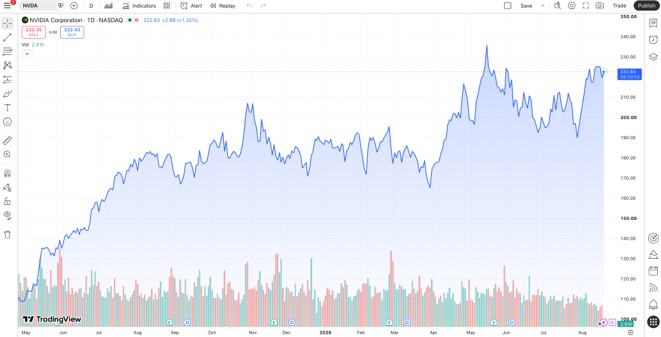
If photonic processors eventually reach large-scale adoption, they could reduce reliance on conventional GPUs for some workloads, a shift that could potentially be reflected in Nvidia stock performance.
A larger figure also circulates: up to 90x lower power consumption and up to 100x greater data center capacity. However, this is framed as the theoretical potential of photonic architectures in general, not a measured result of Q.ANT's chip. The verified product claim remains 30x; 90x represents a ceiling rather than a benchmark. The distinction matters for anyone assessing the technology.
The efficiency comes from physics. Light generates almost no on-chip heat and can execute a complex function in a single optical step that would require thousands of transistors in a silicon chip. According to Q.ANT, one optical element can replace 100 to 1,000 transistors.
Built on a thin-film lithium niobate platform, the processors slot into existing systems via standard PCIe interfaces and support PyTorch, TensorFlow, and Keras, easing adoption.
This is not a GPU killer. Q.ANT's chips are analog, not digital, so they are not based on binary logic and lack native compatibility with algorithms that require precise bit-level operations.
Analysts classify photonic chips as complementary accelerators optimized mainly for inference rather than training, with a software ecosystem far less mature than Nvidia's CUDA. Precision, scalability, and integration remain open questions that the LRZ evaluation is designed to probe.
Q.ANT is not alone: rivals include Lightmatter, Lightelligence, and Celestial AI, the last of which was acquired by Marvell, while incumbents quietly integrate photonics to defend their lead. Observers identify 2026-2028 as the commercial scaling window, with Q.ANT's operational deployments already putting it within that period.
The verdict is measured but real. A €62 million Series A, live deployments in Europe, and a U.S. expansion give this German start-up genuine momentum. It will not necessarily dethrone silicon, but it has moved photonic computing from the experimental realm toward operational deployment, and that alone makes it a company the chip industry can no longer ignore.
