Distributed on behalf of Blue Moon Metals
One of the most essential metals has outperformed gold, silver and copper over the past year.
That metal is tungsten. And the U.S. military can’t build many modern weapons without it. In fact, used in armor-piercing rounds, missiles, tanks, fighter jets and more, there’s no easy substitute for it. And unfortunately, the U.S. hasn’t mined a single ounce of it since 2015. Making matters worse, China controls roughly 80% of the world’s tungsten supply and nearly 90% of the processing needed to turn raw tungsten into a material that manufacturers can use. All of which creates substantial opportunity for companies such as Blue Moon Metals (TSXV: MOON) (NASDAQ: BMM), Almonty Industries (NASDAQ: ALM) (TSX: AII), American Tungsten (TSXV: TUNG) (OTCQX: TUNGF), Fox Tungsten (TSXV: FOXT), and Guardian Metal Resources (NYSE: GMTL) (OTCQB: GMTLF).
The good news is that Washington is finally taking some action. Starting January 1, 2027, U.S. defense contractors will not be allowed to use tungsten that has passed through China at any point in the supply chain. Instead, every major defense contractor in America will need a new source of tungsten. Unfortunately, there’s another problem. That source doesn’t exist yet.
There isn’t a producing tungsten mine in the United States today. And the first new American tungsten production isn’t expected until late 2027. In other words, the new rules could take effect months before the new supply is ready.
That creates a huge challenge for defense companies. They will need to prove something that could soon become extremely valuable: Mine-to-missile. They need to know where their tungsten came from — all the way from the ground to the finished weapon. And they need to prove that China had nothing to do with it. Right now, very few companies can do that. But there is one with an advantage.
That company is Blue Moon Metals (TSXV: MOON) (NASDAQ: BMM).
For one, Blue Moon Metals controls the Springer complex — a facility that General Electric built in the 1980s to help the U.S. compete with China. Now, decades later, that same facility could play a very different role: Helping America rebuild a tungsten supply chain of its own.
In addition, Blue Moon Metals just announced the acquisition of a portfolio of 33 tungsten and antimony projects in the western United States, all of which are proximal to the Company's Springer complex. The Projects are generally located in the most prolific tungsten and antimony producing districts in the United States, with historical production on or adjacent to almost all Projects (see Figure 1). These projects are complementary to the Company's Springer tungsten complex in Nevada and Apex germanium-gallium-copper mine in Utah. The Projects are being acquired on a 100% ownership basis from a private owner on an arms-length basis and consist of BLM and USFS lands. Holding costs for the portfolio are approximately US$162,000/yr.
Jason Dunning, Head of U.S. Special Projects for Blue Moon, stated, "This acquisition marks a meaningful step in Blue Moon’s strategy to build a leading US-focused critical metals platform. The portfolio represents a compelling collection of tungsten and antimony projects in the United States at a time when domestic sources are increasingly important. Many of these Projects historically produced high-grade antimony and tungsten, including reported tungsten grades of up to 14% WO3, during periods of major strategic demand, including WWI, WWII, the Korean War and the Vietnam War. Since that time, the Projects have seen very limited modern work, creating what we believe is a significant opportunity for Blue Moon to apply a disciplined, modern approach across a historically important package of assets. While tungsten was the focus of the historical work, it should be noted that tungsten mineralization may also provide important indications for copper and gold exploration potential. We intend to methodically advance several of these Projects, with a focus on leveraging the Company’s Springer complex in Nevada for potential processing, while seeking to unlock value from the broader portfolio through future monetization opportunities."
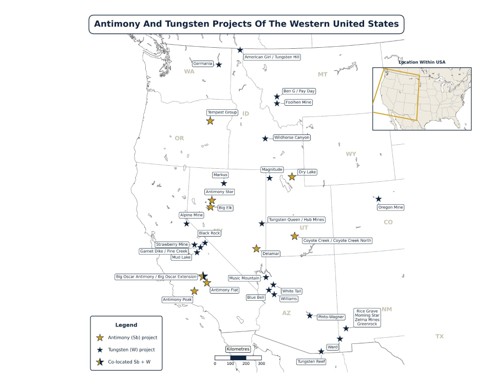
Figure 1. Map of the Projects with Blue Moon’s Springer, Apex and Blue Moon mines.
TRANSACTION
Consideration for the Projects consists of the following:
· 2.8 million common shares of the Company, subject to a 4-month holding period
· A 1.0% NSR royalty on each Project
· US$5.0 million in cash, of which US$2.5 million is to be paid on the closing date and US$2.5 million is to be paid on the first anniversary of the closing date
· A capped inferred resource development milestone payment on tungsten projects advanced by Blue Moon
-- The Development Payments will be based on the grade of the first delineated inferred resource within 15 years of the Closing Date:
* Under 0.15% WO3: US$1.50/MTU WO3
* 0.1501% to 0.30% WO3: US$2.50/MTU WO3
* 0.3001% to 0.45% WO3: US$3.50/MTU WO3
* Over 0.45% WO3: US$4.50/MTU WO3
-- The Development Payments will be paid either in cash or split 50% cash and 50% in Blue Moon common shares, at Blue Moon’s election; and
-- Each Development Payment will be capped at a maximum aggregate payment of US$8.5 million per Project.
· A monetization incentive based on consideration received by Blue Moon from the disposal of any Project:
-- A payment of 10% of the consideration received by Blue Moon, payable in cash or shares at Blue Moon’s discretion; and
-- An inferred resource development milestone payment on tungsten projects advanced by the then owner of each Project within 15 years of the Closing Date, totaling US$1.50/MTU WO3.
KEY PROJECTS IN PORTFOLIO
Blue Moon considers four of the Projects to be high priority for direct shipping high-grade tungsten ores to its Springer Complex:
Oregon Mine, Colorado
The Boulder County Tungsten District forms a south-west to north-east belt about 9.7 km long (about 6.0 miles) and 1.6 to 4.8 km wide (about 1.0 to 3.0 miles) on the east flank of the Front Range, in Precambrian-aged metamorphic and intrusive terrain near the Colorado mineral belt. The dominant rocks are Precambrian Boulder Creek granite and younger Silver Plume granite that are cut by early Tertiary biotite latite dikes and intrusions, locally overlain by Quaternary deposits. The tungsten-bearing veins are Tertiary in age, interpreted by Lovering (USGS Professional Paper 245, 1953) as related to the biotite latite intrusion.
Mineralization is ferberite (with secondary scheelite) in chalcedonic quartz fissure veins (the Oregon, Quaker City and Hildegarde veins) in the Boulder Creek granite. Historically, there is documented production in the USGS Professional Paper 245 of approximately 5,000 short tons with an average grade of about 14.51% WO3 between 1907 and 1929, noting that it is from hand-sorted vein ore that a qualified person has not verified and that must not be relied upon for the mineralization associated with this important target. The veins are narrow and typically high-grade in the district. No modern exploration, no drilling under a documented program, no QA/QC-controlled sampling, and no metallurgical test work has been carried out.
Wildhorse Canyon, Idaho
Tungsten was discovered at Wildhorse Canyon in August 1953 and mined by Cordero Mining Co. between 1954 and 1958. Recorded historical production between 1954 and 1957 was approximately 12,000 tons of ore mined from Steep Climb, Hard to Find and Beaver, yielding 7,461 short ton units (149,220 lb) of WO3 (Mitchell, 1999) or a grade of 0.62% WO3. Historical exploration drilling totaled eleven holes (4,724 feet) on Steep Climb (1982) and two holes (205 feet) on Hard to Find (1985); collars and assays are not in the public record and are unverified.
The deposits are reduced / calcic scheelite skarns (tactite) developed where leucogranodiorite to "alaskite" dikes intruded and metasomatically replaced impure, micaceous marble bands enclosed in biotite gneiss, migmatite and quartzite. Mineralization is structurally controlled along the crest of a north-northwest trending (N15 to N20 W) asymmetric anticline and is restricted to tactite in impure marble adjacent to the dikes; pure marble is barren. Ore minerals are scheelite with molybdenite in epidote and chlorite-garnet tactite; trace beryllium is reported. Bodies are tabular lenses and pods, generally 5 feet or less thick, over a mineralized horizon traced and projected for about 5.7 km (about 3.5 miles).
Williams, Arizona
The Williams Project is hosted in a light-colored, coarse-grained granite, locally banded or gneissoid, and it is cut by irregular aplite and pegmatite dykes. Tungsten mineralization occurs as huebnerite (MnWO4), the manganese-rich end of the wolframite series, as bladed crystals (to about 7.5 cm) enclosed in quartz and along mica seams within gently north-dipping quartz veins associated with an aplite dyke. Two vein sets are documented in the district: a gently north-dipping set (about 18 to 30 degrees north) striking approximately east-west (N70 to N80 W underground), which hosts the productive Williams vein; and a steeply north-dipping set of broadly parallel strike, which appears less productive. The principal vein was explored over approximately 195 metres (about 640 feet) of strike and about 97.5 metres (about 320 feet) down-dip.
Documented exploration and development on the Project was carried out by historical operators between 1902 and 1955 and consisted of hand and conventional underground development: three upper adit levels (the 200-, 260- and 280-feet levels), a lower haulage adit (the “0” level), an inclined winze and connecting raises, totaling about 1,200 m (about 4,000 feet) of underground workings on as many as seven levels, together with numerous surface cuts and pits. A total of approximately 88,000 t of ore was historically mined over the mine life at a grade of 0.75% WO3. No systematic modern exploration (geochemistry, geophysics, modern drilling) has been documented since the 1961 United States Bureau of Mines (USBM) circular.
Hub Mines, Nevada
The Hub Mines deposit is a tungsten-bearing quartz-vein system hosted in a Jurassic quartz monzonite intrusion within the Basin and Range Province. Mineralization occurs in at least six narrow quartz veins arranged in a north-east-trending, en-echelon array, dipping approximately 55 to 75 degrees to the west; the principal vein, the Hub Vein, has a documented strike length of more than 400 metres (about 1,300 feet). Vein widths range from a few centimeters to about 1.5 metres (a few inches to 5 feet). The dominant ore mineral is huebnerite (MnWO4), with subordinate wolframite and scheelite, and minor to trace lead, silver, gold, copper, fluorite, and locally antimony. The recorded average mill-feed grade for historical production was approximately 1.4% WO3, and one shipment of hand-sorted ore is recorded at about 20% WO3 that a QP qualified person has not verified and that must not be relied upon for the mineralization associated with this important target. The 1983 USBM survey records that no workings have explored the depth of the mineralized veins, so the veins are interpreted to remain open at depth.
Exploration and development of the Hub Mines are entirely historical including the original surface shipments from 1899, subsequent underground development including a main adit of about 549 metres (1,800 feet) with an inclined raise of about 152 metres (500 feet) to surface, near-surface stoping along about 300 metres (1,000 feet) of strike, a 50-ton gravity concentration mill operated between 1911 and 1916, placer work in 1941, and dump reworking between 1950 and 1955. The most recent technical work on the Project has been reconnaissance sampling and mapping by the USBM in 1981 and 1983 (MLA 56-83). No modern exploration, no drilling under a documented program, no QA/QC-controlled sampling, and no metallurgical test work have been carried out.
OTHER
Blue Moon anticipates hiring a team to manage the Projects and advance the Key Projects to the drilling stage over the next two years. The Company sees the potential to commence direct shipping ore from one or more of the Key Projects within three years.
This Transaction also marks Blue Moon's foray into antimony. There are at least five Projects that historically were high grade, former direct ship ore sites within the portfolio (2-10% Sb in high grade veins). The concept is either to sell the ore to a third party or, in due course, or build a small-scale antimony smelter at the Springer site. There are two such facilities in the US; one in Alaska and one in Montana, also at a small scale.
The Transaction is subject to TSX Venture approval and is expected to close in October 2026. No finder’s fees are being paid on this Transaction.
Other related developments from around the markets include:
Almonty Industries, a leading global producer of tungsten concentrate, announced the commencement of processing plant throughput operations at its Sangdong Mine in Gangwon Province, South Korea. During June 2026, the Company began feeding stockpiled run-of-mine ore through its newly commissioned processing plant to produce saleable tungsten concentrate – a pivotal milestone marking Sangdong’s transition from mine development into active, revenue-generating operations. Almonty exited the first quarter of 2026 with approximately 120,000 tonnes of ore stockpiled at an average grade of 0.24% tungsten trioxide (“WO₃”). During the second quarter of 2026, the Company mined an additional approximately 19,700 tonnes of development ore at an average grade of 0.35% WO₃, while advancing 214.6 meters of underground development, primarily along the Main Vein. Together, this brings total stockpiled ore to approximately 139,700 tonnes at a blended grade of approximately 0.25% WO₃ ahead of the plant’s commissioning. We are utilizing lower-grade throughput during the initial ramp-up phase and anticipate higher grades as the process advances, with Sangdong’s low-grade ore approximately three times higher than that of our Panasqueira mine in Portugal. With throughput now underway, stockpiled ore is being introduced during the initial commissioning phase to optimize ore blending and maintain the consistent feed quality the plant requires as the operation ramps up. The Sangdong Mine processing plant is designed to upgrade run-of-mine ore into a high-purity tungsten concentrate.
American Tungsten announced several milestones toward advancing the Ima Mine, the Company’s past-producing tungsten mine located in Idaho, USA, where the Company continues to advance exploration activities aimed at expanding and further defining the scale of the historic tungsten system. “Our objective remains clear: systematically advance the project through exploration, resource development, engineering studies and permitting activities. The geological and technical work completed to date continues to demonstrate the strength of the mineralized system and supports our belief that there remains meaningful opportunity to expand the project’s long-term potential. In addition to the progress being made through drilling and resource development, our ongoing technical and due-diligence work has further enhanced our understanding of the continuity of key mineralized structures across the district, reinforcing the strategic importance of the Ima Project and the opportunities it may present as we continue to advance development plans,” said Ali Haji, President and CEO of the Company. “American Tungsten remains focused on advancing the Ima Project toward an updated Mineral Resource Estimate in the near term, providing the foundation for a Preliminary Economic Assessment to follow shortly thereafter.” The current drill program is designed to expand known mineralized structures along strike and at depth, with a particular focus on underexplored areas that exhibit strong geological continuity. The Company’s work to date has successfully advanced its objective of growing the resource base while further demonstrating the district-scale potential of the Ima Project. Results from six additional drill holes confirm that tungsten-silver mineralization in the No. 5 and No. 7 veins continues across more than 900 feet of strike length. In addition, drilling intersected multiple stacked footwall veins and extended the main Ima vein system over 800 vertical feet down dip.
Fox Tungsten provided an update on its fully funded 20,000 metre diamond drill program at the Fox Project in British Columbia, where drilling has successfully intersected visible scheelite mineralization in multiple target areas, including several previously unrecognized parallel mineralized zones at Fox North. Analytical results have not yet been received. However, visual observations from drilling completed to date provide encouraging indications that the Company's exploration program is successfully expanding the mineralized system. Highlights: Scheelite observed in 100% (3 of 3) exploration holes completed at Fox North. Scheelite observed in 100% (7 of 7) RC resource expansion holes drilled to date. Two diamond drill rigs operating; 20,000 metre program progressing on schedule. Initial assay results expected in the coming weeks. Fox North: Scheelite mineralization is visible in all three exploration holes at Fox North completed to date. Drilling has intersected multiple new parallel mineralized zones located between 375 meters and 675 meters west of the BK Zone. These new mineralized zones strengthen the Company's confidence in the geological model that the Fox deposit comprises a series of stacked, parallel tungsten-bearing zones and support the potential for significant expansion of the current Mineral Resource both laterally and vertically across parallel zones. RC Zone: Visible scheelite mineralization has been observed in all seven resource expansion holes drilled to date at the RC Zone. These scheelite-bearing intersections extend the known mineralized footprint to the south towards the BN Zone and support the Company's interpretation that mineralization remains open along strike.
Guardian Metal Resources, a strategic exploration company focused on tungsten in Nevada, USA, announced that it has entered into a strategic partnership with the Montana Mining Association to collaborate on a tungsten mining and recovery pilot program supporting domestic defense applications. The Partnership is also being advanced in conjunction with Montana Technological University and the Army Research Laboratory. As part of the Partnership, Guardian Metal will supply stockpiled legacy ore from its Tempiute Tungsten project, located near Rachel, Nevada, approximately 150 miles northeast of Las Vegas. Tempiute, formerly known as the Emerson Tungsten Mine, is a significant past producing tungsten mine, which was originally discovered in 1916 and most recently operated during the 1980s. As a critical defense metal, tungsten has been formally designated a strategic priority by the U.S. government. Guardian Metal's mission is to advance its co-flagship projects, Tempiute and Pilot Mountain, as a cornerstone of U.S. tungsten supply, directly supporting national efforts to reshore production. This strategy is expected to reduce reliance on foreign supply chains, strengthen economic and defense security, and deliver long-term value for shareholders. Matt Vincent, Executive Director of MMA, commented: "We are excited to work with Guardian Metal on this Partnership, which we feel is incredibly important to the industry and our nation's security. Guardian Metal's Tempiute material represents what we believe will prove to be an important domestic source of tungsten for this Partnership, as well as a demonstration of our Association's ability to effectively establish a broader network of critical minerals projects across the Mountain West."
Legal Disclaimer / Except for the historical information presented herein, matters discussed in this article contains forward-looking statements that are subject to certain risks and uncertainties that could cause actual results to differ materially from any future results, performance or achievements expressed or implied by such statements. Winning Media is not registered with any financial or securities regulatory authority and does not provide nor claims to provide investment advice or recommendations to readers of this release. For making specific investment decisions, readers should seek their own advice. Winning Media is only compensated for its services in the form of cash-based compensation. Pursuant to an agreement Winning Media has been paid three thousand five hundred dollars for advertising and marketing services for Blue Moon Metals by Blue Moon Metals. We own ZERO shares of Blue Moon Metals. Please click here for full disclaimer.
Contact Information:
Ty Hoffer
Winning Media
281.804.7972
[email protected]
